The Gap Doesn't Disappear. It Moves

A federal court exhibit shows $157 million in promoter losses on the same shows where Live Nation recorded $158 million for itself. The document was marked confidential. It did not stay that way.
When Live Nation settled with artists and co-promoters after a show, the numbers they presented showed losses. Thin margins. Costs that ate into backend payouts. Promoters in the red.
The same shows told a different story internally.
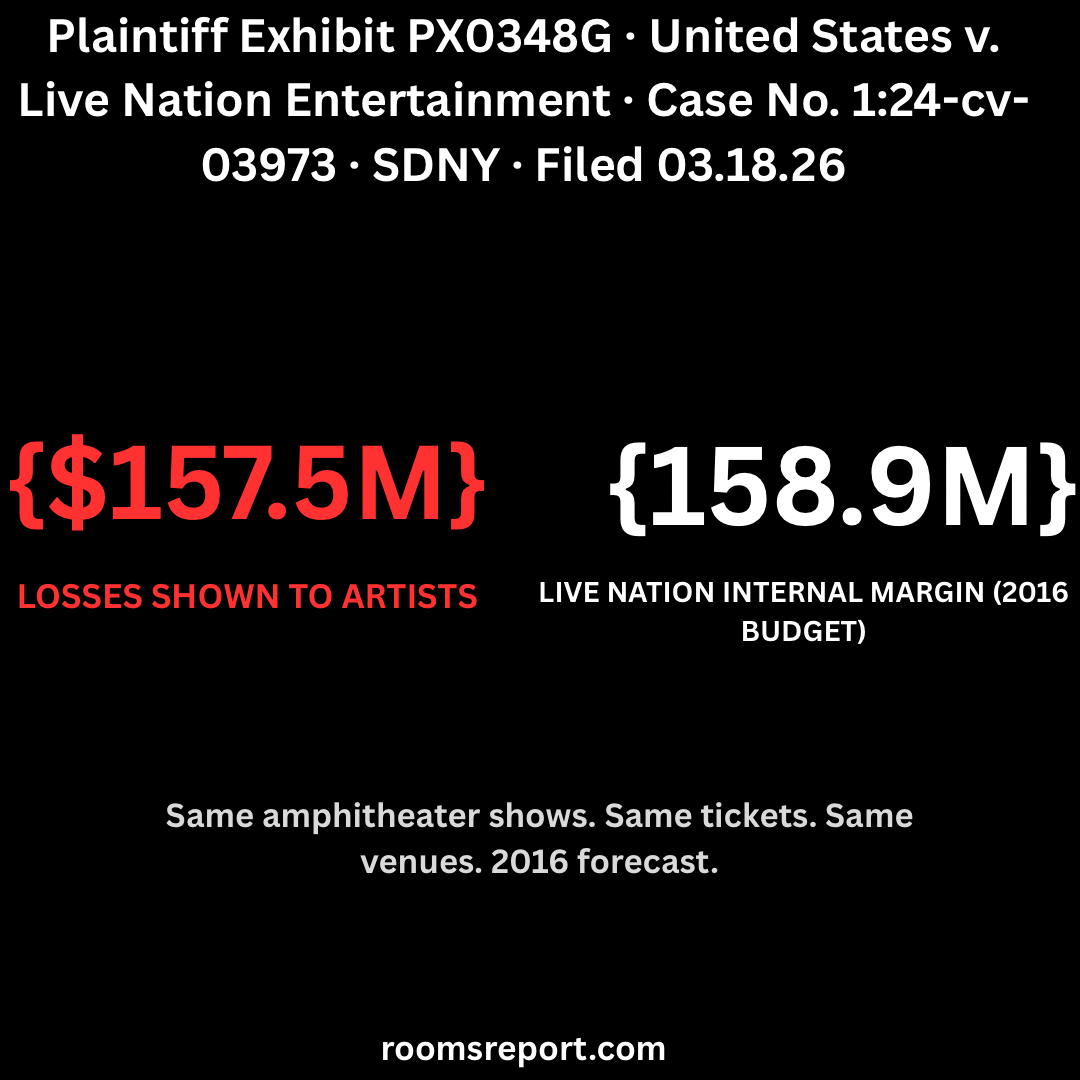
Plaintiff Exhibit PX0348G, entered into evidence in United States v. Live Nation Entertainment, Case No. 1:24-cv-03973, U.S. District Court Southern District of New York, shows two columns for the same amphitheater shows in the same period. Promoter Loss: $157.5 million. CM, Live Nation's internal Contribution Margin: $158.9 million budgeted.
Live Nation fought to keep the document sealed. It was unsealed. The numbers are now public record.
CM stands for Contribution Margin. It is the internal metric Live Nation uses to measure what each show actually contributes to the company's overall profitability. It measures gross revenue minus variable costs and reflects the true economic benefit to Live Nation as a consolidated entity.
The Promoter P&L is what artists and co-promoters see. It deducts venue-controlled operations and production costs that Live Nation controls through its venue division but charges to the talent side of the ledger. The result is that costs Live Nation controls appear as expenses against artist earnings.
Live Nation's own internal documents describe this as a transfer pricing scheme. An internal document referencing Show Cost Control acknowledges the friction directly: "Operations and production costs have increased, which has led to friction as these are controlled by Venues but sit in the Talent P&L."
The costs are controlled by one division. The bill goes to another. The artists pay it.
This is not a new observation.
On July 30, 2024, Live Nation CFO Joe Berchtold was asked by analyst Peter Supino of Wolfe Research to parse the contribution from Venue Nation versus the concert promotion function. Berchtold responded on the record: "So first, on the Venue Nation versus the concert promotion, really because that's transfer pricing, we don't spend a lot of time trying to separate the two. We don't have, I would say, fully distinct P&Ls that would give you at the AOI level what you're asking about."
No distinct P&Ls. The same structure PX0348G documents.
On April 10, 2026, five days before a federal jury found Live Nation guilty of illegal monopolization, NBC News investigative reporter Gretchen Morgenson published a report based on internal Live Nation documents. Her reporting documented discrepancies between show profit calculations provided to artists and co-promoters versus Live Nation's internal figures. She framed it as "two sets of books".
PX0348G is one of those books.
Thomas Dorfman, CEO of Juice Entertainment, has direct knowledge of the accounting structure. His company sued Live Nation in 2011. Case No. 2:11-cv-07318, U.S. District Court, District of New Jersey. In 2011, a Live Nation executive called him "street kids" in a federal court exhibit and said he could not produce an event.
Last week a jury said Live Nation illegally monopolized the industry he was shut out of.
Dorfman has reviewed the transfer pricing documents from the antitrust trial. "Live Nation in the operated venues pays themselves the rebate through funneling the money to different corporate divisions," he said. "For the artist and co-promoter it always ends up in the P&L as an expense. Live Nation gets paid by the artist and co-promoter through this accounting scheme for their benefit exclusively."
He added: "In Live Nation owned and operated venues the artist and co-promoters are not allowed to question any costs or expenses. I have it in their internal documents."
The jury verdict on April 15, 2026 found Live Nation liable for operating an illegal monopoly. The verdict addressed market control. PX0348G addresses something more specific. It addresses what happens to the money inside that market after the show is over.
The promoter loses $157.5 million. Live Nation records $158.9 million. Same shows. Same tickets. Same venues.
The gap does not disappear. It moves.
PX0348G is Plaintiff Exhibit entered in Case No. 1:24-cv-03973-AS, Document 1252-7, filed March 18, 2026, marked LNE Confidential Business Information. Joe Berchtold’s statement is from the Live Nation Entertainment Q2 2024 earnings call, July 30, 2024, transcript available via Live Nation investor relations and Seeking Alpha.
Documentation is held and available upon request.